

Who is it for?
- Tourists admitted to hospital in Sousse or still at their hotel, throughout the tourist area: Port El Kantaoui, Hammam Sousse, Chott Meriem and the seafront.
- Foreign residents living in Sousse, retirees or expatriates, who wish to receive treatment or continue their recovery in their home country.
- Families and insurers looking for an operator on the ground to coordinate everything.
Four ways to return, depending on the patient’s condition
The transport method is never chosen at random: it depends on the doctors’ assessment. Here are the options we organise.
Option
Seated scheduled flight with an escort
- Suitable patient : Stable patient able to sit
- How it works : A nurse or doctor travels alongside the patient
Scheduled flight with oxygen
- Suitable patient : Stable patient needing oxygen during the flight
- How it works : Airline-approved oxygen and a medical escort
Scheduled flight on a stretcher
- Suitable patient : Patient who must remain lying down
- How it works : Stretcher installed in the cabin, with a medical team on board
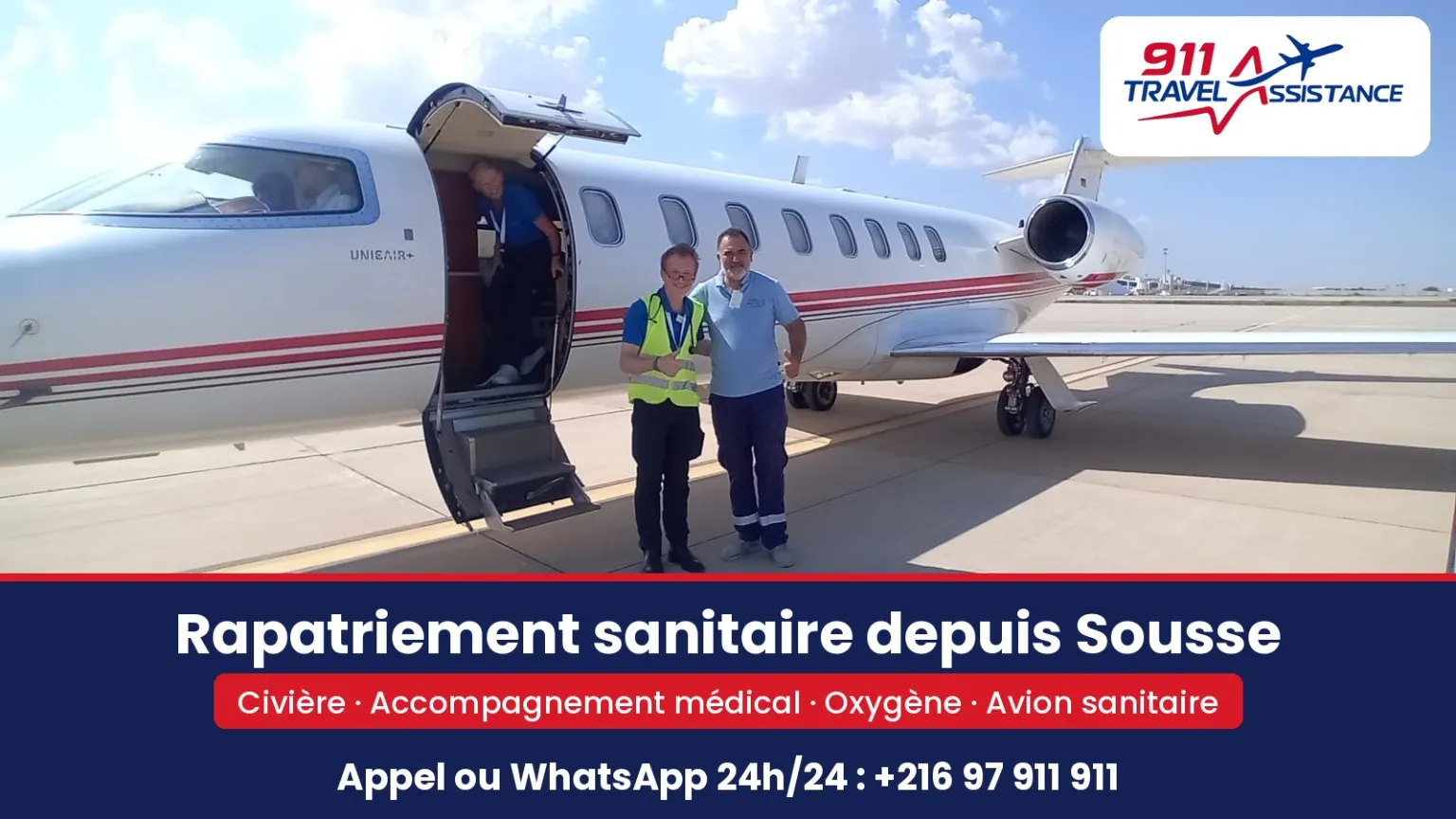
Air ambulance
- Suitable patient : Seriously ill or unstable patient requiring intensive care
- How it works : Dedicated aircraft equipped as an intensive care unit
Nursing or medical escort
For a stable patient, a nurse is often sufficient: they monitor vital signs, administer treatments and help with mobility. If the patient’s condition warrants it, a doctor accompanies them from door to door.
With or without oxygen
Cabin air contains less oxygen than air at ground level. For some patients with heart or respiratory conditions, oxygen during the flight is essential. We prepare the medical request required by the airline and the necessary equipment.
On a stretcher
After a pelvic or femoral fracture, major surgery or a stroke, the patient cannot travel sitting up. Several seats are then reserved to install a stretcher, screened off by a curtain, with a dedicated medical team.
By air ambulance
This is the solution for the most serious or urgent cases: a ventilated patient, someone on a continuous infusion or requiring intensive care monitoring. The aircraft collects the patient and flies directly to the airport closest to their destination hospital.
How repatriation from Sousse works
1. First call. The family, hotel, clinic or insurer contacts us. We collect the medical records.
2. Medical assessment. Our doctors speak with the clinic’s and insurer’s doctors to confirm that the patient can travel and choose the appropriate option.
3. Organisation. Booking the flight or air ambulance, completing airline medical forms and reserving a bed at the destination hospital.
4. Departure day. Our ambulance collects the patient from their hotel, home or clinic in Sousse and takes them to the aircraft at Monastir, Enfidha-Hammamet or Tunis-Carthage Airport.
5. Arrival. An ambulance meets the patient on landing and takes them to their hospital or home. The family is kept informed at every stage.
Who pays for repatriation?
Most often, it is covered by travel insurance, assistance linked to a bank card or the resident’s international health insurance. We contact the insurer directly, send medical reports and work with them until departure.
Without insurance, a detailed quotation is prepared before any arrangements are made.
Arrange repatriation from Sousse
Call or WhatsApp +216 97 911 911, 24 hours a day, 7 days a week, or email rapatriement@911travelassistance.com. Our team answers in French, English, German, Italian, Polish, Portuguese, Czech and Arabic.
911 Travel Assistance — Medical repatriation from Sousse and throughout Tunisia — 911travelassistance.com